
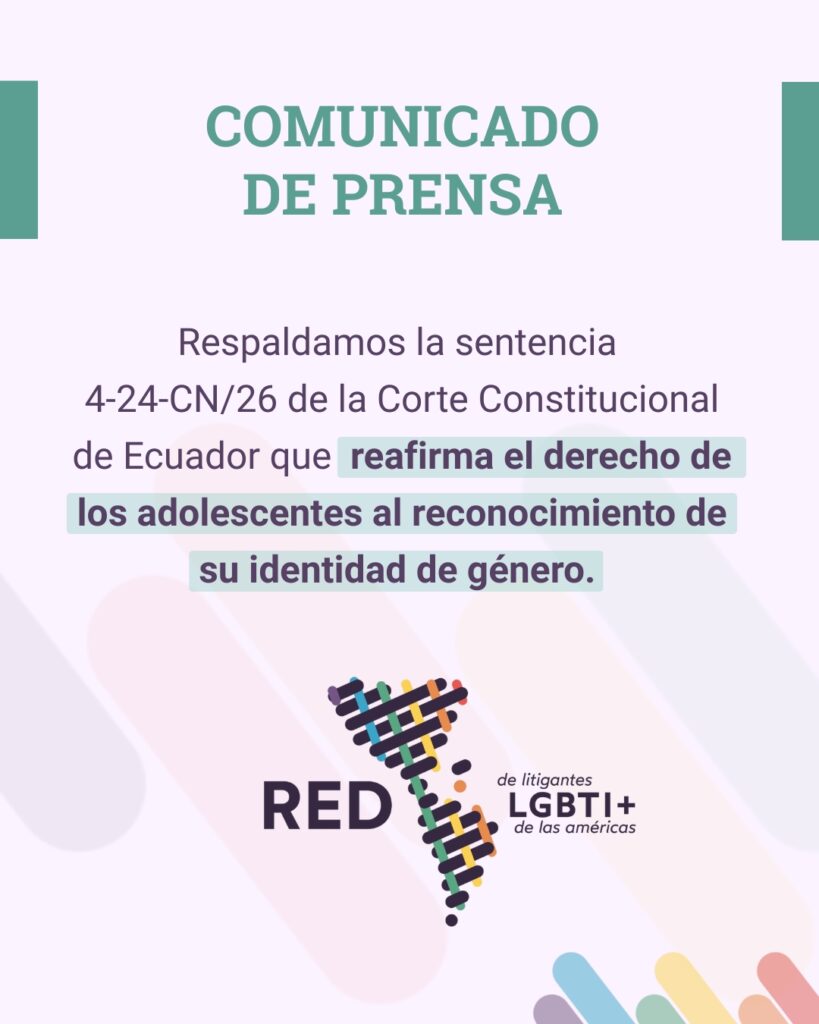
He 10 March 2026 The Constitutional Court of Ecuador made public the sentence 4-24-CN/26, in which he learned of the case of a teenager from 15 years to whom the Civil Registry of Ecuador denied the request to modify the gender component in their identity document, which he presented accompanied by his parents.
The denial was supported in the article 94 of the Organic Law on Identity and Civil Data Management, that requires the age of majority (18 years) for this procedure. Given the decision of the administrative entity, The teenager's parents filed a protection action, which resulted in the hearing judge raising a query to the Court about the constitutionality of the norm due to its potential to violate the rights of trans adolescents..
The Constitutional Court determined that the automatic application of the age requirement for the modification of the gender component is unconstitutional in cases involving adolescents who have the support of their legal representatives and technical support that proves sufficient maturity to make free, voluntary and informed decisions about their gender identity..
Based on the interpretation of the rights to free development of personality, to identity and principles such as the best interests of the child and progressive autonomy, The Constitutional Court of Ecuador points out that conditioning the rectification of gender in official documents to the age of majority perpetuates and ignores the capacity of all adolescents to have full understanding of the effects of their decisions and limits their life project..
From the Network we consider that this sentence should be applied in accordance with the provisions of the Inter-American Court in its Advisory Opinion 24/17 in which it determined that the recognition of gender identity must be based exclusively on free and informed consent, without requiring medical or psychological certificates. In addition, It should be remembered that the WHO in the latest version of the International Classification of Diseases (CIE-11) removed gender incongruity from its catalog, thus ceasing to consider it a psychiatric pathology.
This ruling of the Constitutional Court, that recognizes gender identity as an essential dimension of human dignity and reaffirms that adolescents must also have their right to self-determination and identity guaranteed, constitutes a key reference for the region and an important example of how to incorporate and respect inter-American standards of human rights protection without discrimination..
Therefore, We observe with concern the reaction of the Transparency Commission, Citizen Participation and Social Control of the Legislative Assembly of Ecuador, in particular his intention to monitor the effects of the sentence. Although the exercise of political control is legitimate within a democratic system based on the separation of powers, It is alarming that this mechanism can be exploited to promote scenarios of persecution or stigmatization., both against trans adolescents who will be protected by the decision, their relatives, as well as against the very composition of the Constitutional Court for having made this decision.
It is essential to remember that constitutional courts play an essential role in protecting minorities against possible majority pressures.. In this sense, The Inter-American Court of Human Rights has been clear and consistent in its jurisprudence in maintaining that decisions adopted by majorities cannot serve as a basis for ignoring or restricting the human rights of LGBTI+ people.. On the contrary, States have the obligation to guarantee that state action does not perpetuate or reproduce the historical and structural discrimination that these populations have faced..
It is imperative to remind the National Assembly that Ecuador ratified, he 07 May 2024, the Inter-American Convention Against All Forms of Discrimination and Intolerance (A-69). This binding instrument obliges the State, under your Article 4, to prevent and punish any manifestation of hatred or intolerance, prohibiting public support for discriminatory activities.
Added to this framework are the General Observations of 2025 of the Committee on the Rights of the Child, that specifically recommend that Ecuador implement measures to eradicate gender stereotypes and eliminate structural discrimination against LGBTI children and adolescents in all areas. By allowing oversight to serve as a platform for groups that violate these rights, The Commission not only fails to comply with international treaties, but ignores specific mandates for the protection of children, attacking legal security and social peace.
Consequently, Any institutional initiative that seeks to review or supervise the effects of this ruling must be conducted with strict adherence to inter-American and universal standards for the protection of human rights and be guided by the principles of equality and non-discrimination., as well as respect for gender identity as a category protected by the American Convention, avoiding generating situations that put safety at risk, the dignity or full enjoyment of rights of people directly protected by the judicial decision, especially when it comes to teenagers.
We use our own and third parties to obtain statistical data on the navigation of our users and improve our services. If you accept or continue navigating, We consider that it accepts its use. You can change the configuration or get more information by clicking here
Necessary cookies are absolutely essential for the website to function properly. This category only includes cookies that guarantee basic functionalities and security features of the website.. These cookies do not store any personal information.
Cookies that may not be particularly necessary for the operation of the website and that are used specifically to collect personal data from the user through analysis, Ads and other embedded content are called non-necessary cookies. It is mandatory to obtain the consent of the user before executing these cookies on your website.
