
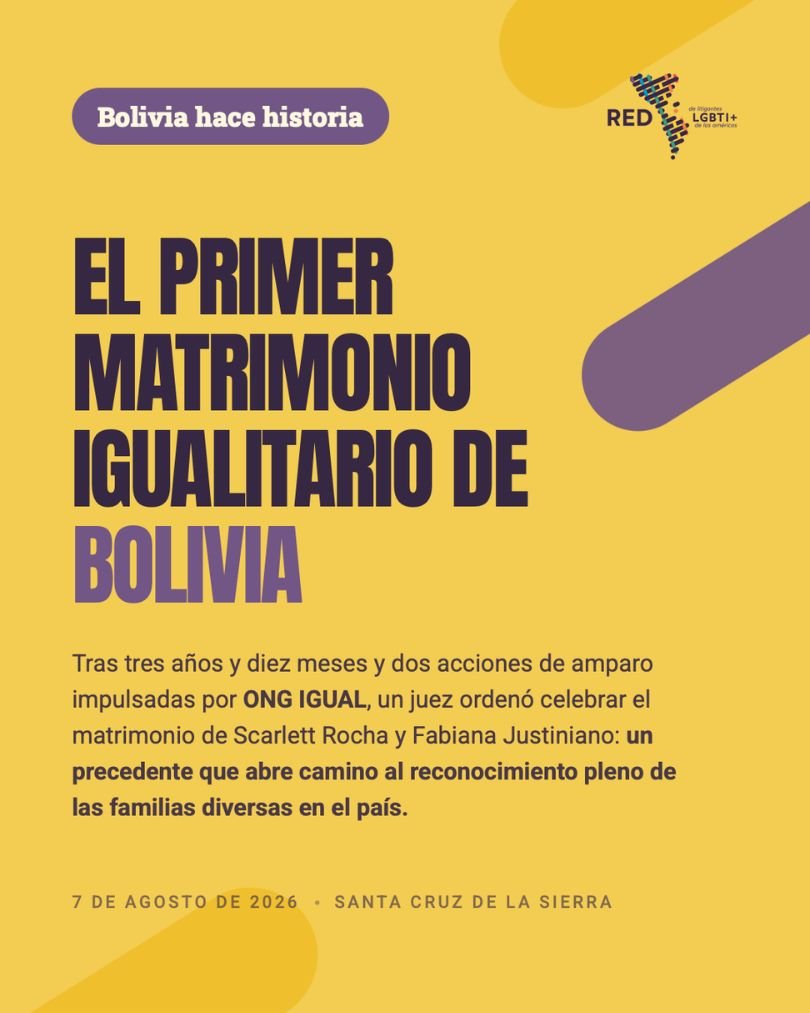
He 7 August 2026, in the city of Santa Cruz de la Sierra, Scarlett Rocha and Fabiana Justiniano were declared wives, marking a milestone in the history of Bolivia by being the first civil marriage between people of the same sex registered in the Andean country.
This act was the result of a long administrative process and two constitutional protection actions promoted by our member organization., NGO EQUAL, for three years and ten months.
This effort not only transformed the lives of Scarlett and Fabiana, but today It represents hope for thousands of diverse families who seek to have their life projects recognized and protected by the State..

This process dates back to 12 October 2022 when the Justiniano Rocha couple submitted their request for civil marriage to the Civic Registry Service (SERECI). The petition was rejected with the argument that Bolivian legislation does not recognize marriage between people of the same sex and that the available figure is free union..
Faced with the refusal of the registry entity, The couple filed two actions for constitutional protection; the first due to the lack of a formal response and the second due to the substantive denial of their request., by the departmental and national bodies of SERECI. Both actions were based on the violation of family rights, equality and non-discrimination, dignity and free development of personality.
The SERECI based its denials on the article 63 of the Political Constitution of the State of Bolivia which establishes that “the marriage between a woman and a man "It is constituted by legal ties and is based on the equality of rights and duties of the spouses." and "free or de facto unions that meet conditions of stability and singularity, and are maintained between a woman and a man without legal impediment, They will produce the same effects as civil marriage...” . Nevertheless, The same Constitution prohibits all forms of discrimination based on sexual orientation and recognizes the right to equality before the law., to the dignity and protection of the family in a broad sense.
In this sense, the jurisprudence of the Plurinational Constitutional Court (TCP) was central to IGUAL's argument to challenge the decisions of the Civic Registry Service, since the high court had previously recognized free union for same-sex couples. In a ruling of 2023 ordered the SERECI to register free unions of people of the same sex, invoking the figure of conventionality control.
In addition, urged the Plurinational Legislative Assembly to adapt internal regulations to international human rights standards on the matter. Although this decision did not open the possibility of the institution of marriage, laid the foundations for its formal recognition in same-sex couples.
Finally, he 13 March 2026 The Justiniano Rocha couple managed to obtain a favorable resolution that ordered the celebration of the civil marriage to be made viable.. The favorable resolution obtained through the protection guarantee, interprets that the exclusion of same-sex couples from civil marriage constitutes a discriminatory differentiation that does not pass a strict test of equality.

The constitutional judge, guided by conventionality control, the constitutionality block and the article 256 of the Political Constitution of the State, which orders giving preference to international human rights treaties over less favorable domestic norms; interpreted the article 63 of the Constitution in accordance with the American Convention on Human Rights and the jurisprudence of the Inter-American Court, privileging the most favorable interpretation in light of the pro-person and progressive principles.
With it, reaffirmed the standards developed in the Advisory Opinion 24/17, relating to the recognition of civil marriage between same-sex couples.
The resolution that allowed the marriage of Fabiana and Scarlett does not repeal the article 63 of the Bolivian Constitution nor does it establish a general rule on equal marriage. It is a concrete statement, obtained through protection, which orders SERECI to celebrate this specific marriage.
In that sense, The Justiniano-Rocha case redefines the Bolivian constitutional debate. The tension between the literality of the article 63 and the international obligation of non-discrimination has found, through protection, a concrete response that privileges equality and dignity for all people.
This is a significant precedent that paves the way for widespread protection. In addition, shows that, in the face of legislative inaction, The constitutional guarantee of protection can open access to the marriage institution. This advance not only marks a milestone in Bolivia, but it can become a reference for the region: Fabiana and Scarlett's fight demonstrates how it is possible to pave the way towards full recognition of rights in countries that still face similar obstacles.
The next step, inevitably, will correspond to the Plenary Chamber of the Constitutional Court or the Legislative Assembly: consolidate jurisprudentially or legislate in a general way what this advance has made possible in a particular case.
We use our own and third parties to obtain statistical data on the navigation of our users and improve our services. If you accept or continue navigating, We consider that it accepts its use. You can change the configuration or get more information by clicking here
Necessary cookies are absolutely essential for the website to function properly. This category only includes cookies that guarantee basic functionalities and security features of the website.. These cookies do not store any personal information.
Cookies that may not be particularly necessary for the operation of the website and that are used specifically to collect personal data from the user through analysis, Ads and other embedded content are called non-necessary cookies. It is mandatory to obtain the consent of the user before executing these cookies on your website.
