
How can we measure the solidity of a democracy if not through its ability to protect those whom the majority tend to make invisible??
For the LGBTI+ Litigators Network of the Americas, The answer is a technical and political premise: There is no real democracy if human dignity is not guaranteed or protection against the decisions of the majorities that, many times, they seek to exclude us.
The past 19 March, we participate in the Public Hearing on the Request for Advisory Opinion (OC-33), presented by the Republic of Guatemala, focused on Democracy and its protection in the Inter-American Human Rights System.
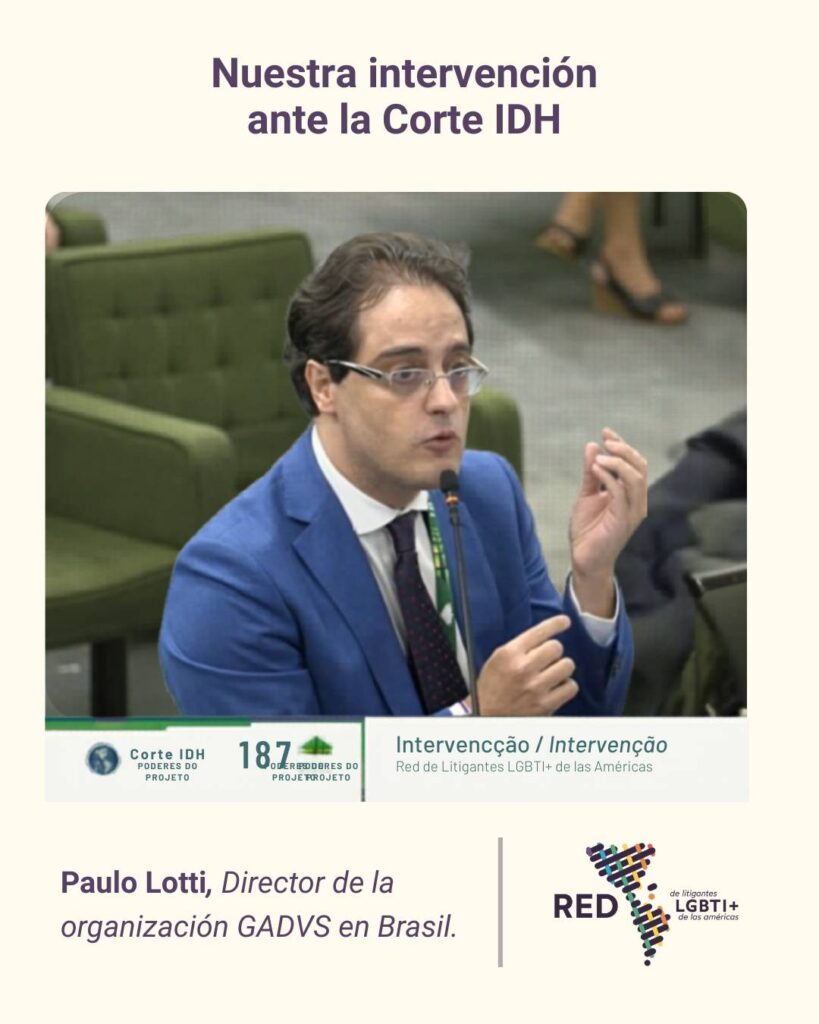
Editorial note: next, We present the complete intervention carried out by Paulo Iotti, Director of GADVS (Brazil) and representative of our Network in this hearing before the judges of the Inter-American Court.
Most Excellent Inter-American Court, my name is Paulo Iotti, I am president of the Group of Lawyers for Sexual and Gender Diversity (Brazil) and I honorably represent the LGBTI+ Litigators Network of the Americas.
The human right to democracy is immanent to the systematic and teleological interpretation of the American Convention, which establishes the minimum—and not the maximum—that States must guarantee. In this sense, Democracy is the condition of possibility for human rights to be exercised.
Democracy is not limited to elections and majority decisions, As the Court stated in the case Chavarria vs.. Nicaragua (December 2025). There is no democracy if there is no countermajoritarian guarantee of the rights to respect for human dignity, to substantive equality and real freedom, ensuring that there are no setbacks in the rights achieved.
Substantive democracy has the essential function of correcting structural social asymmetries and guaranteeing the human rights of all people., especially of minorities who, being dehumanized by prejudice, require special protection of material equality by the States.
Formal democracy only fully exists if citizenship is guaranteed as the “right to have rights”, invoking Hannah Arendt's classic expression. Historically marginalized groups are often unable to fully participate due to the discrimination they face..
In the case of LGBTI+ people, Physical or symbolic violence generates fear that prevents many from living openly and, but still, join parties or exercise the right to be voted. This lack of representation in spaces of power generates laws designed by people who are unaware of our realities., based on discriminatory stereotypes.
Democracy loses legitimacy when majority decisions are made without social diversity in deliberation. The lack of a plural composition and even the absence of public audiences that listen to marginalized groups generates the invisibility of experiences that are essential for inclusive policies..
We request that the Court affirm the obligation of States to adopt:
Affirmative actions: to ensure the participation of LGBTI+ people in parties and spaces of power in an intersectional manner.
Legal security for organizations: guarantee the registration of rights defense associations without using vague clauses such as “public morals” oh go “good manners” to deny them.
Protection against political violence: ensure that those in elected office do not suffer dehumanizing offenses for defending equality.
In the case of trans people, The non-recognition of their gender identity harms their right to participate in electoral processes. Documents with data other than their identity inhibit them from going to vote.
In addition, The guarantee of the right to life is essential. Lethal violence against LGBTI+ leaders is alarming: between 2023 y 2024, were reported at least 49 homicides of LGBTI+ social or political leaders in the region. These attacks seek to silence dissident voices through a politics of fear. It is imperative that States adopt protocols to guarantee a vote free of violence and policies that strengthen minority leadership..
We must reaffirm the unconventionality of hate speech and misinformation about LGBTI+ people. The right to freedom only allows conduct that does not cause harm to third parties.; Intolerant speeches destroy the self-esteem of victims and harm their political participation. It is a duty of the States to prevent and sanction these speeches, because they are not protected by freedom of expression.
Finally, We maintain that there is an autonomous human right to democracy in the American Convention. This would allow the Court to verify the absence of minimum conditions in states that act with clientelism., stating that there is no “weighing” that legitimizes such regimes.
As a constitutionalist, I suggest to the Court a minimalist approach to decide this issue safely. Minorities need this understanding of substantive democracy for their real protection..
We celebrate that, together with the collective voice of the Network, our member organizations will also contribute their expert vision individually before the Court: Of Justice (Colombia), CELS (Argentina) y Robert & Ethel Kennedy Human Rights Center (EE. UU.).
We use our own and third parties to obtain statistical data on the navigation of our users and improve our services. If you accept or continue navigating, We consider that it accepts its use. You can change the configuration or get more information by clicking here
Necessary cookies are absolutely essential for the website to function properly. This category only includes cookies that guarantee basic functionalities and security features of the website.. These cookies do not store any personal information.
Cookies that may not be particularly necessary for the operation of the website and that are used specifically to collect personal data from the user through analysis, Ads and other embedded content are called non-necessary cookies. It is mandatory to obtain the consent of the user before executing these cookies on your website.
